

Christmas Light Decorations on Houses: Holiday Lighting for Different Architectural Styles

At MosquitoNix®, we know that every home is different. That's why no two homes will be decorated the same way during the holiday season. When it comes to Christmas light decorations on houses, you want your display to complement your home’s unique architectural style and features. You may own a Victorian house, a modern house or even a Colonial house that was built hundreds of years ago. Don’t be afraid that the professionals only have one package in the bag and reuse it for everyone in the neighborhood. Having professionals help you bring your vision to life isn’t about what they want, it’s about what your family wants to see every day during the holidays.
Our MosquitoNix Elves have provided professional holiday lighting services for countless homes and businesses over the years, so they understand that every structure is beautiful in its own way, with unique features to draw attention to. The best displays start there: light the lines and focal points that define your home's style, and keep everything else in a supporting role. Keep reading as these lighting experts share some tips for Christmas light decorations on houses in a particularly flattering way for your home's architectural style. We discuss some common types of American homes below. Find the style that most closely reflects that of your home and learn what our Elves recommend.
Colonial Homes
We'll begin with American Colonial homes. They commonly feature simple, clean lines, pitched roofs and front entrances placed in the center, with windows on either side for an overall symmetrical appearance.
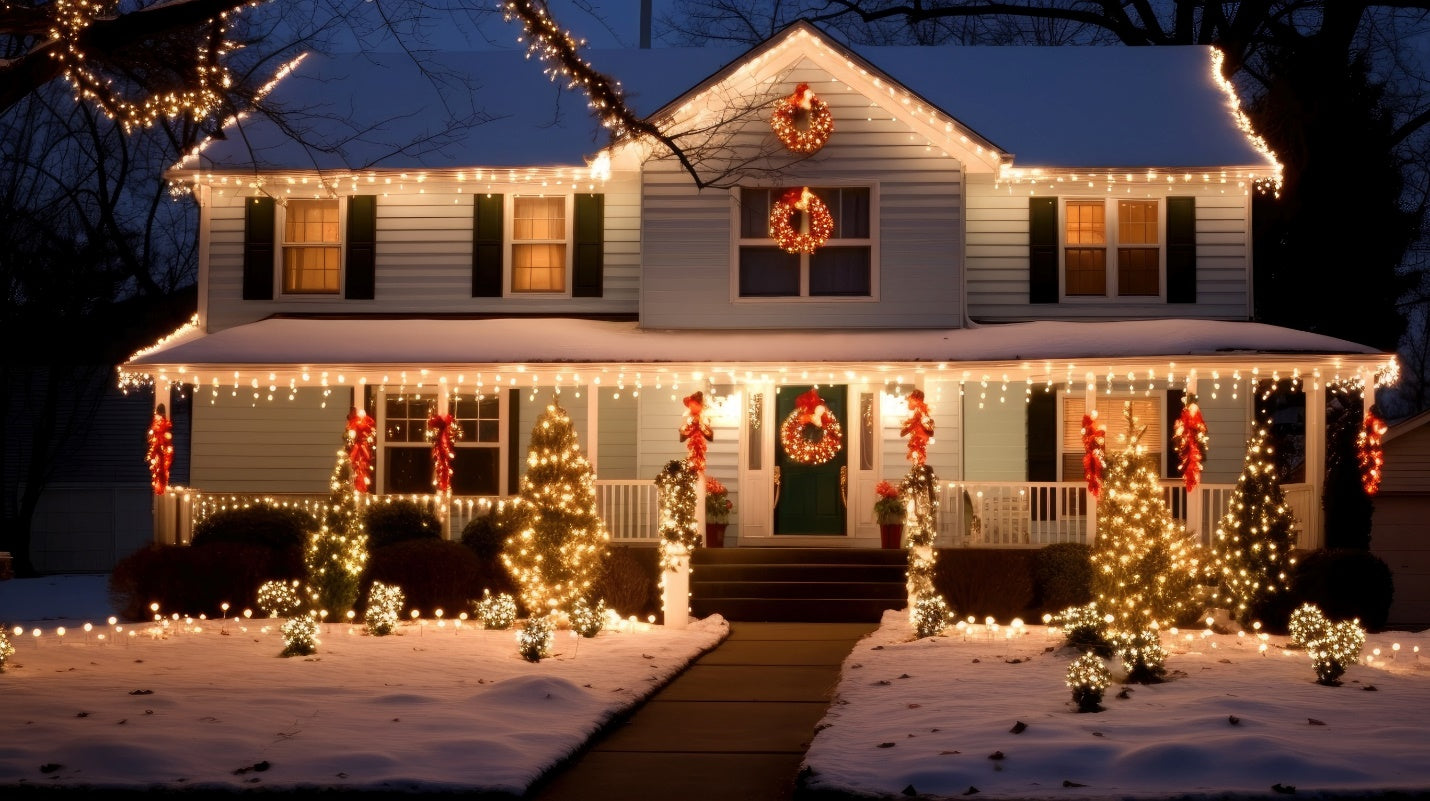
Play up the symmetry of a Colonial by illuminating each window with an electric candle or a lighted Christmas wreath. Then, make the front entrance a focal point. One popular way to do this is by hanging lighted garland around the front door. If a path extends out from the door, consider adding lights to trees, bushes or fencing on either side of the path, or placing battery- or solar-powered luminaries along either side.
It should also be noted that, due to the old-fashioned style of these homes, a popular decorating choice is to primarily use white Christmas lights that mimic the glow of candlelight. To that end, white incandescent holiday lights traditionally have a warmer, more candle-like look than LED white lights, which tend to be more cool-toned. However, it's getting increasingly easy to find LED white lights with a warmer look, so you can enjoy the energy efficiency of LEDs and a candle-like glow at the same time. This gives a romantic feel with a slight throwback to the original way homes were decorated with only candles glowing on the tree and in windows. A classic, simple look that is always on trend.

Victorian Homes
Victorian homes are more elaborate than Colonials in terms of their features and general structure. In fact, they are almost the opposite of Colonials in many ways. While Colonial homes are usually square or rectangular, Victorian homes usually have more complicated or elaborate shapes, often with towers, gables and elaborate trim. They typically have prominent front porches as well.
Similar to Colonial homes, many people like to reflect the historical nature of Victorian homes in the way they light them for Christmas. That means that they also tend toward lights in classic, warm white. However, some people like to reflect the often-colorful paint jobs of their Victorian homes by using colored string lights, which can also look lovely. If the home is colorful, playing against those colors could offer a bold, whimsical look. You could soften the color palette by sticking with all white or all blue to offset the colors on the house. This is where a color expert Elf would come in handy.
In addition, the dramatic lines of the roofs are often well served by using icicle-style lights rather than standard string lights; with their light strands that extend downwards, these lights have an extra bit of visual interest that draws the eye up.
One note of caution: Victorian buildings are already so intricate and interesting to look at that adding too many different holiday lighting styles, colors and Christmas light decorations on houses can start to look overly busy.
You can help avoid this by making sure you have a focal point. In the case of Victorian homes, owners often take advantage of their lovely front porches, making them the main attraction. You can place decorated Christmas trees in the center of your porch, or wind-lighted garland around the porch's columns and put a nice, big lighted wreath on the front door.
Cape Cod Homes
There are many different types of Cape Cod homes, depending on the era in which they were built. However, one defining characteristic is that Cape Cods are generally on the small side, akin to cottages. Like Colonials, they tend to have a symmetrical design and a steeply pitched roof. Many Cape Cods also feature dormer windows.
Because they are on the smaller side, Cape Cods can potentially look overpowered if there are too many lights and decorations, so as with Victorians, you want to keep that in mind. Luckily, other than that, there are few "rules" when it comes to lighting a Cape Cod home for Christmas. White or colored lights are sure to look equally lovely, especially since many Cape Cods are painted a neutral gray. But colorful strands would really stand out against the gray and brown hues of these homes and would bring a pop the eye wouldn't miss.
And since the front entrance is generally in the center of the house, as with Colonials, it tends to make a good focal point. If your Cape has dormer windows, those are also great features to highlight. Think of them as eyebrows complementing the "face" of your house and consider highlighting them with lighted garland and wreaths.
Ranch and One-Story Homes
Ranch homes are one-story houses with a long, low profile and a low-pitched roof. That horizontal shape is their defining feature, so the most flattering displays follow it. A single, continuous line of lights along the main roof edge gives the house definition from the street, and it reads best when the bulbs and spacing stay consistent from one end to the other.
Because the roofline sits low and stretches wide, the front entrance and windows can easily get lost. Give the eye a place to land by framing the front door with lighted garland or a wreath, then use lights on shrubs or along the walkway to lead toward it. On a long ranch, a few repeated accents, such as matching wreaths on evenly spaced windows, look more polished than lighting every feature at once.
Mid-Century Modern Homes

Mid-century modern houses are striking due to their clean, straight lines that can look incredible when highlighted with a simple string of lights. These modern houses sometimes have textured exterior walls made with materials like stone or rough wood. That makes them particularly good candidates for uplighting with spotlights or well lights, to bring out an interesting, dramatic result.
In addition, mid-century modern homes can benefit from slightly whimsical holiday lights that are, well, modern. Try star-shaped or snowflake-shaped lights, or neon-style lighted signs. Don't be afraid to experiment with different light colors, either. Plus, you can take advantage of the large, plentiful windows common among this type of house by showcasing your beautiful Christmas tree inside.
Choosing the Right Lights for Your Home
Not all lights are created equal. When planning your display, consider different styles of Christmas lights such as classic incandescent bulbs, energy-saving LEDs, or eco-friendly solar-powered strands. The right choice depends on your home’s architectural features, your budget, and the look you want to achieve. This ensures your decorations are both beautiful and practical.

Match Bulb Size and White Tone to Your Home
Bulb size is a question of scale. Larger bulbs, such as C7 and C9 strands, read clearly along a main roofline and on homes set back from the street, while mini lights suit closer details like railings, dormer windows, and shrubs. For a fuller rundown of strand types, see our holiday lighting glossary.
Whichever bulbs you choose, keep one white tone across the main architectural lines. Warm and cool whites side by side can make a roofline look patchy, so save contrast for color accents, or carry color across the whole display if your home suits a bolder look.
Professional Tips for Safe and Stylish Christmas Light Decorations
When planning Christmas light decorations on houses, focus on balancing safety, durability, and style. Quality outdoor lights designed for winter weather are essential.
Different styles of Christmas lights, from classic white strings to colorful LEDs or icicle lights, can highlight architectural features and add charm. Minimalist designs create a timeless look, while bold contrasts make your home stand out.
For the best results, consider professional installation. Our Elves hang your lights and décor on the date you schedule, keep the display bright through the holidays, then take everything down and store it when the season ends.
Contact the Holiday Lighting Experts
There are many different types of homes, and yours might not fit neatly into one of these categories, but hopefully, this guide gives you some parameters to work with. You don’t have to stick to the style that is traditionally best suited for your home, and you don’t have to stick to one style. Layering and mixing can be exciting — as long as you have professionals to help keep you on track. If you have specific holiday lighting questions or need professionals to help you create stunning Christmas light decorations on houses, call or text (877) 731-2847 or request a free quote to learn how the MosquitoNix Elves can help you.
Holiday Lighting FAQs by Home Style
What Christmas Lights Work Best on a Colonial Home?
Colonial homes have strong symmetry, so lights that follow it look most natural. Outline the roofline and dormers with classic warm white C7 or C9 strands, and our holiday lighting glossary covers the full range of bulb sizes if you want to compare options. Frame each window evenly and center a wreath on the front door. Keeping the display balanced on both sides of the façade reinforces the architecture rather than competing with it.
How Should I Light a Victorian Home for the Holidays?
Victorian homes have a lot going on, with turrets, wraparound porches, gingerbread trim, and bay windows, so the risk is overdoing it. Pick one or two focal points, such as the front porch and the main gabled roofline, and light those well rather than outlining every detail. Warm white or multicolor lights both suit the style, and garland wound around porch columns with a wreath on the front door gives the eye a clear place to land.
How Do I Decorate a Ranch or One-Story Home With Christmas Lights?
The long, low roofline is the defining feature of a ranch home, so follow it with one continuous, consistent line of lights from end to end. Because the roofline sits low and the house stretches wide, the front door can get lost, so frame it with candle-lit garland or a wreath and use lights along the walkway or on shrubs to draw the eye toward it. For more on building a display around a focal point, see our decorating tips guide from our team of lighting professionals.
What Holiday Lighting Works on a Mid-Century Modern Home?
Mid-century modern homes favor clean lines and minimal ornamentation, so the lighting should match. Stick to a single color or warm white, follow the dominant horizontal lines of the roofline and eaves, and avoid dense wrapping or heavy garland. Less is more on this style, and a precise, restrained display reads as intentional rather than understated.
When Should I Book Holiday Light Installation?
Book as early as you can, because installation dates can fill up as the season approaches. Most families reserve by October or early November to secure a date before the Thanksgiving rush. Call us today or request a quote.
What Should I Share When Requesting a Quote?
Tell us which areas of your property you want lit and the look you have in mind. That is usually enough for our team to put together a no-obligation quote.
Leave a comment
Comments will be approved before showing up.


