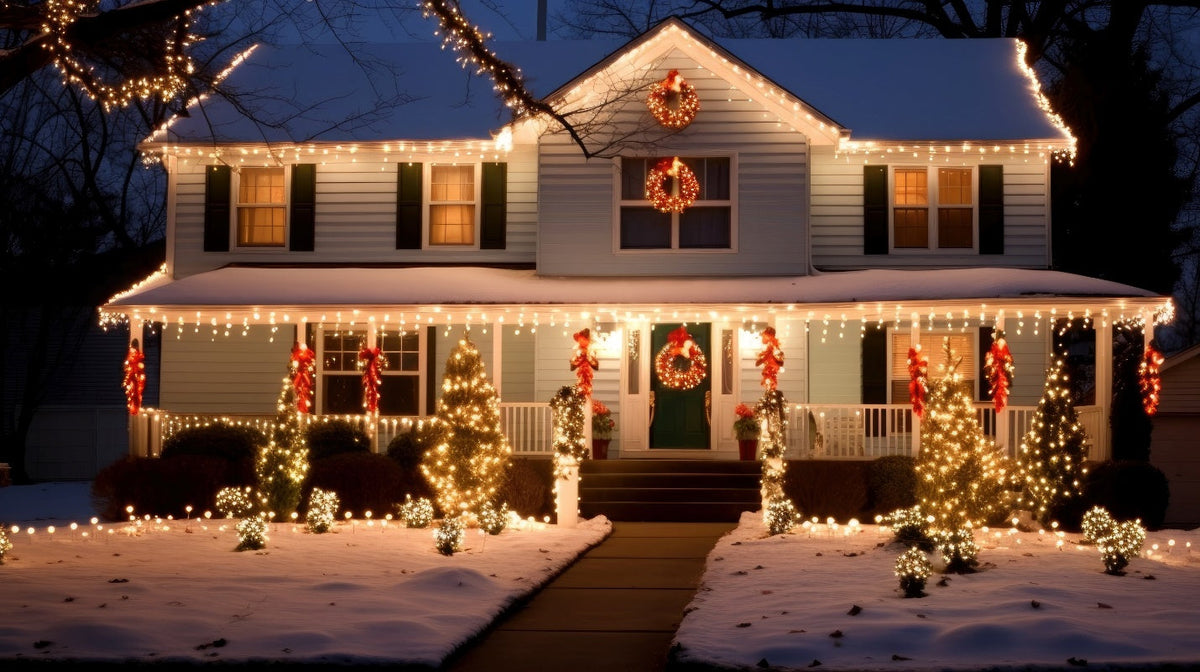


Creating a Show-Stopping Holiday Light Display: Tips from Professional Decorators

Nothing says Christmastime quite like a stunning holiday light display. Whether set up at your home or business, a well-designed, well-executed display can make neighbors and passersby smile as it lights up the cold days and long nights of winter.
The team of holiday lighting design and installation professionals at MosquitoNix® is here to help. Our MosquitoNix Elves know how to install Christmas light displays that catch eyes and spread joy - just check out our image gallery to see some of our work on real homes and businesses. Keep reading as they share some top tips for how to hang Christmas lights in a way that will bring holiday cheer all season long.
For a professional-looking holiday light display, plan the coverage and the power source first, test every strand before it goes up, put larger bulbs on the roofline and smaller ones in the trees, keep the spacing even, and give the house one or two focal points with accent pieces used sparingly. The five tips below walk through each step, and the sections after them cover bulb choices, hanging technique, and when to hand the job to the MosquitoNix Elves.
Top 5 Tips for Creating a Professional-Looking Light Display
1. Create a Plan Ahead of Time
With any holiday lighting project, our Elves recommend planning the look you want ahead of time. Take measurements to ensure you'll have enough light strings to cover all the areas you want to. Also, figure out where the power source is that you will connect to, and be sure you won't be overloading your circuits. Plug outdoor strands into a GFCI-protected outlet, keep each extension cord to a few strands rather than one long chain, and put the display on an outdoor timer so it shuts off when you go to bed. Our post on the hidden dangers of hanging your own holiday lights has a short checklist for the electrical side. If you work out these details in advance, it can help avoid problems later.
2. Check Your Bulbs in Advance, Too
Make sure all your light strings illuminate correctly by testing them before you start hanging them. Troubleshooting and replacing any burned-out bulbs in advance can save you time and struggle in the long run, as well as help ensure your bulbs burn their brightest, since burned-out bulbs can be a drain on the whole string. If one section of a strand stays dark while the rest lights up, a loose or burned-out bulb in that section is the usual cause, so reseat or replace it before you write off the strand. If the whole strand is dark, check the small fuses in the plug before buying a replacement. Retire any strand with cracked sockets or frayed wire rather than patching it, since damaged strands are a fire risk once they are on the house.
3. Integrate Unique Accent Pieces
When it comes to creating a truly show-stopping light display for your home or business, a stunning accent piece or two can go a long way. An article on Martha Stewart's website concurs with this point, stating that, when it comes to Christmas lights, "the possibilities go far beyond trees and rooftops": You can incorporate lights in "beautiful, unexpected ways," including illuminated signs, chandeliers and more. It's just a matter of finding the unique pieces that work for you.

4. Remember That Sometimes, Less Is More
Even though it can be a good idea to add eye-catching accents, our team advises against using too many. Whether you're adding large star-shaped lights or glowing topiary balls, remember that a little can go a long way. It's usually best to be judicious with your accent pieces in terms of the number of them and where they're placed.
5. Choose a Focal Point
When you're working on your initial lighting designs, make sure you select one or two areas or features that you especially want to highlight. It may be your front door, a certain tree or a pair of bay windows. Whatever you choose, you can help create a more unified look by drawing the most attention to these areas. Our guide to holiday lighting for different architectural styles shows which features make natural focal points on Colonial, Victorian, Cape Cod, and mid-century modern homes.

Pick Bulb Sizes and Colors That Fit Each Part of the Display
Professional displays rarely use one kind of light everywhere. Larger C9 bulbs outline rooflines, eaves, and doorways, where their size reads from the street, while mini lights wrap tree trunks and branches and net lights cover shrubs quickly and evenly. Putting the bigger bulb on the architecture and the smaller bulb in the landscaping keeps the house, rather than the yard, as the main event.
Pick one white and stay with it. Warm white has a candlelight glow that suits traditional homes, while cool white reads icier and more modern, and mixing the two across the same view looks like a mistake rather than a choice. Incandescent whites tend to run warm and LED whites cooler, though warm-white LEDs are easy to find now, so you can keep the glow and the lower power draw.

LEDs also stay cooler to the touch and let you connect more strands on one run than incandescent lights do, which matters on a long roofline. Our holiday lighting glossary walks through icicle, net, string, and permanent lights if you want to compare the options before you buy.
Hang Lights So They Look Professional
The difference between a tidy display and a sagging one is mostly technique. Keep the spacing between bulbs even along every run, let the lights follow the roofline instead of cutting across peaks, and end each run at a corner rather than mid-wall. Pull the strand just taut enough to stay straight without straining the sockets.
Attach lights with clips made for gutters, shingles, or brick rather than staples or nails, which damage the surface and leave crooked lines. Clips also keep the weight off the gutters, which matters because a gutter pulled away from the house can let water in. Run extension cords down behind downspouts or along the foundation so they disappear after dark, and keep every strand and connection rated for outdoor use.

For ladder setup, roof peaks, and the step-by-step of getting lights onto gutters, see our guide to how to hang Christmas lights.
Bonus Tip: Hire Professional Christmas Light Installers
As you can see, a lot goes into the creation of a truly professional-looking light display. While our Elves are happy to share these tips with you for your DIY holiday light installation project, they're also happy to take on the labor of installation, maintenance and even take-down. As Forbes Magazine explains, professionals can save you time, reduce your risk of injury and help you get the look you want. Hiring makes the most sense when the job involves a second story or a steep roofline, tall trees or palms, a large property, or a calendar with no free weekend before the holidays. The MosquitoNix Elves start with a custom quote, install on the date you schedule, fix any bulb that goes out during the season, and take everything down and store it when the holidays end. Our guide to holiday lighting installation costs explains what shapes a quote.
Text ELVES or call (855) 808-2847, or request a custom quote from the MosquitoNix Elves, to learn more about how the Elves can work with you to create the kind of light display you always dreamed of but never thought you could achieve for your own home or business.
Holiday Light Display FAQs
When Should I Put Up Christmas Lights?
Hang lights on a dry, mild day in the fall, before cold or wet weather makes roofs slick and before the rush that follows Thanksgiving. You can leave them unlit until you are ready to switch the display on. If you plan to hire installers, book in the fall, because installation dates fill up quickly as the holidays approach.
How Many Christmas Lights Do I Need for My House?
Measure each run you plan to light, such as the roofline, the porch, and each doorway, and compare the total to the strand length printed on the box. Buy at least one spare strand per run, and keep strands of the same brand and bulb type together on each run so the colors match.
Do the MosquitoNix Elves Provide the Lights, or Do I Buy My Own?
The Elves supply commercial-grade lights and materials with every installation, so there is nothing to buy. If you would rather use lights you already own, ask your local team when you request a quote, and they can check that the strands are rated for outdoor use and that the count is right for the areas you want lit.
Leave a comment
Comments will be approved before showing up.